The Boat Page

The Boat is an eleven ton work in progress. She is a Friendship Sloop built on the Maine coast in the later half of the 20th century, a sister ship to a boat built in 1903. When we bought her she was only eleven-years-old, but a lack of proper maintenance had led to a rapid decline. We bought her in 2000 (I say we because I co-own her with a family in Oregon).

THE RESTORATION
I took a three month sabbatical from work to do the major repairs and to strip out what there was for an interior. We sailed her that first summer with only the rough pine bunks and bulkheads that I could throw together in the last three days before launch. This actually proved to be a blessing.
All through that first summer as I changed crews and we traveled the coast of Maine from Kittery Point to the Bay of Fundy in Canada and back there was constant opportunity for an exchange of ideas about where everything should fit in the final layout. For specific comments I kept a number two pencil handy and asked folks to write their comments directly on the temporary interior. Thus at the end of the first season the interior was peppered with little inscriptions like “this bench needs to be an inch lower”, or “these need to be three inches further apart”. Much to my surprise virtually none of the comments were mutually exclusive.
Over the next winter I worked to replace the temporary interior. It was the kind of work I really enjoy. As each part of the temporary interior was removed (complete with graffiti-like comments) it became a template for a finished part of the interior.
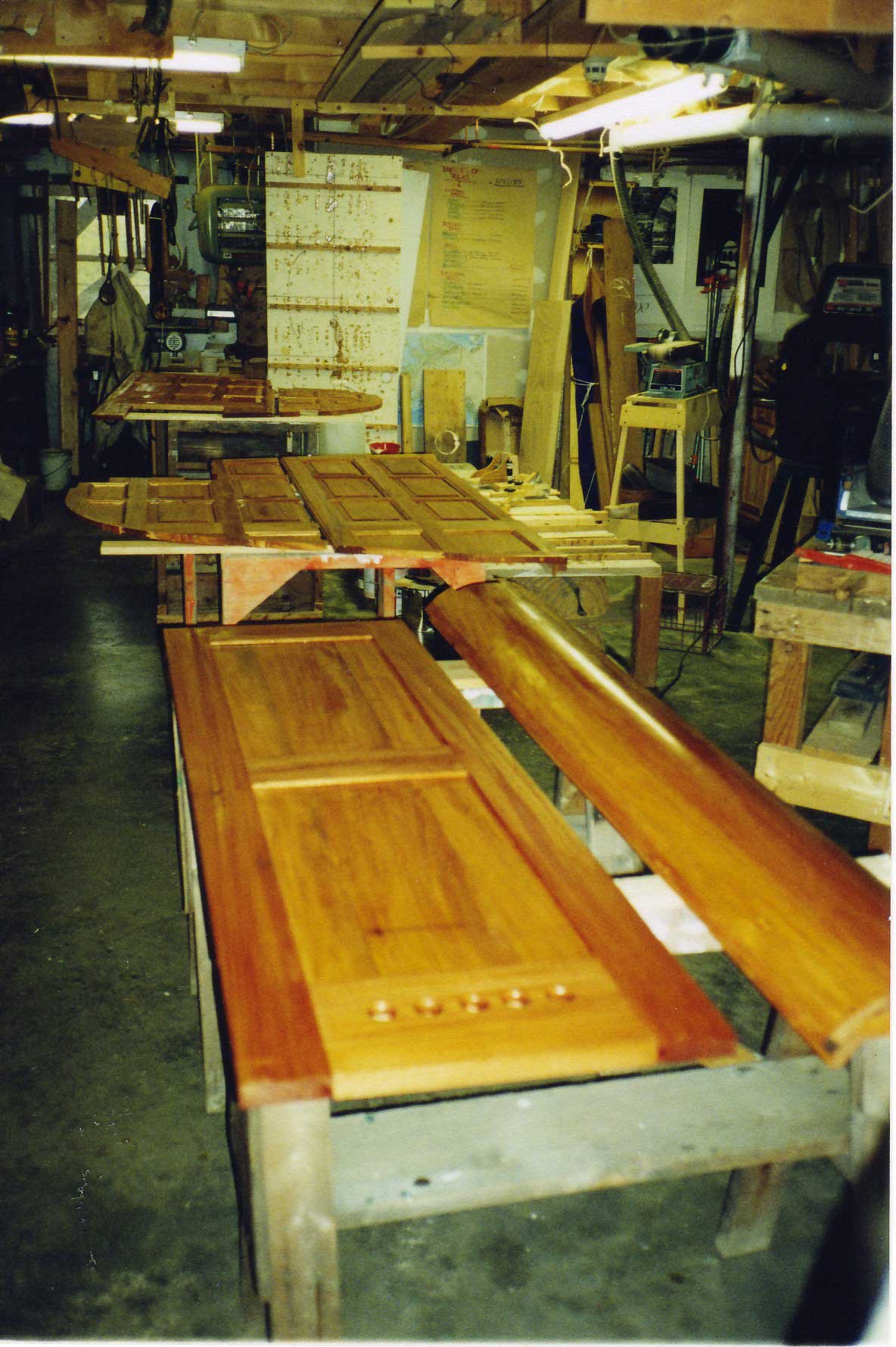
new interior pieces being assembled in the shop
Having these working templates in full scale allowed me to concentrate my efforts on the construction of the actual components and not be constantly worrying about whether what I was making would fit, or was going to be in the right location.
By the start of our second full season the foreword bunks and bulkheads were complete, as were the bunks and settees in the main cabin, and the bulkheads enclosing the head.
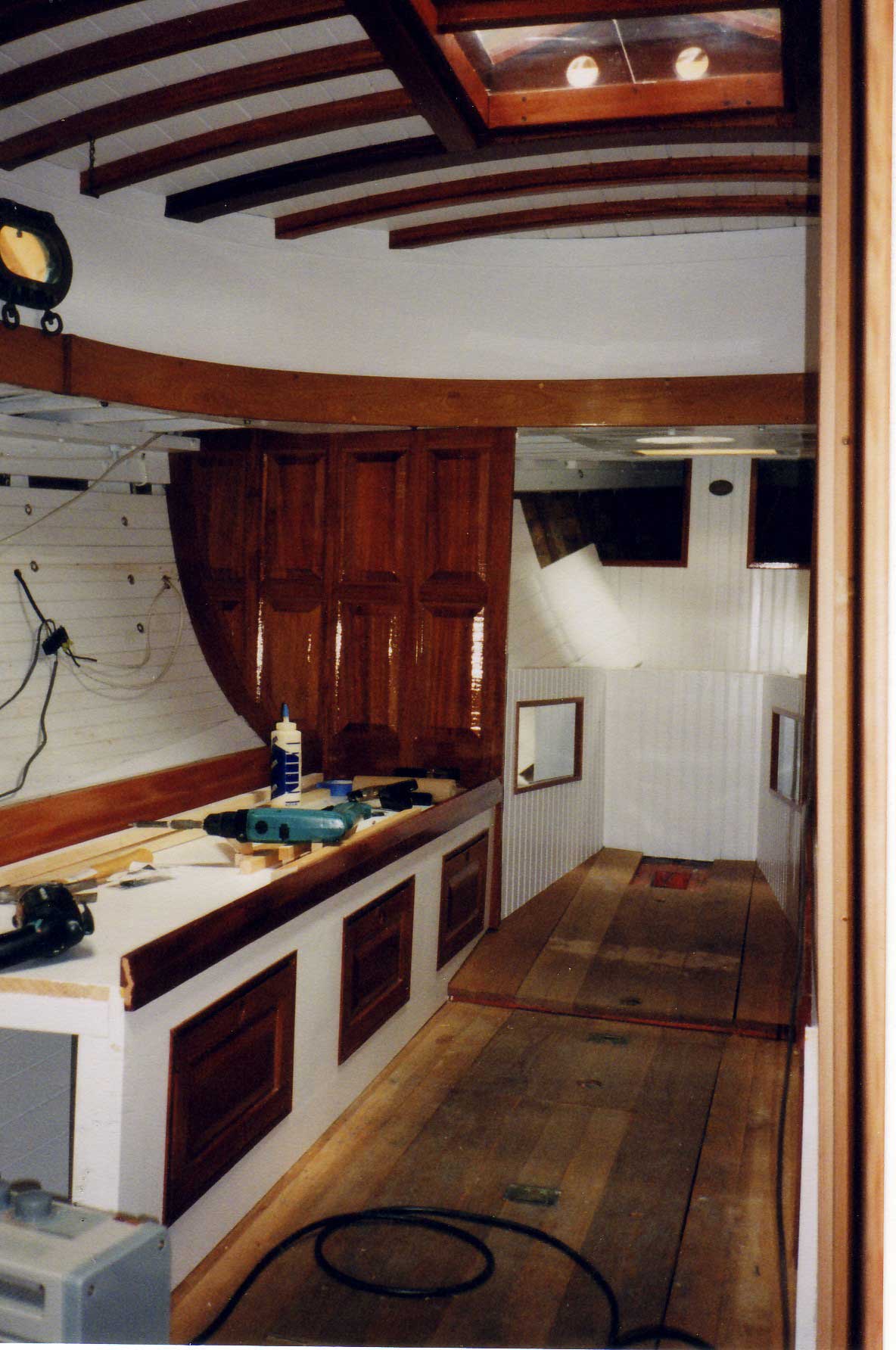
installing the new interior looking forward
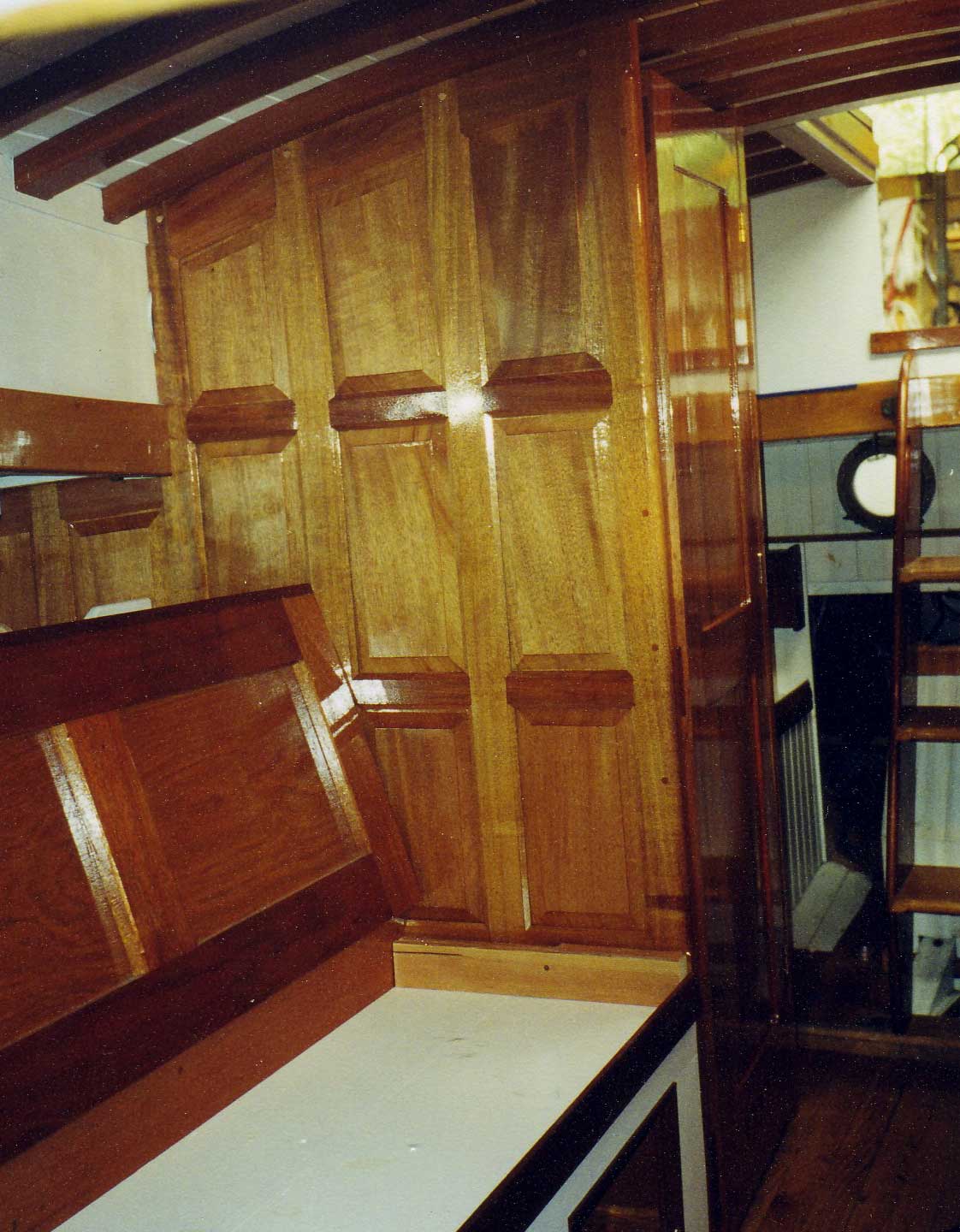
installing the new interior looking aft
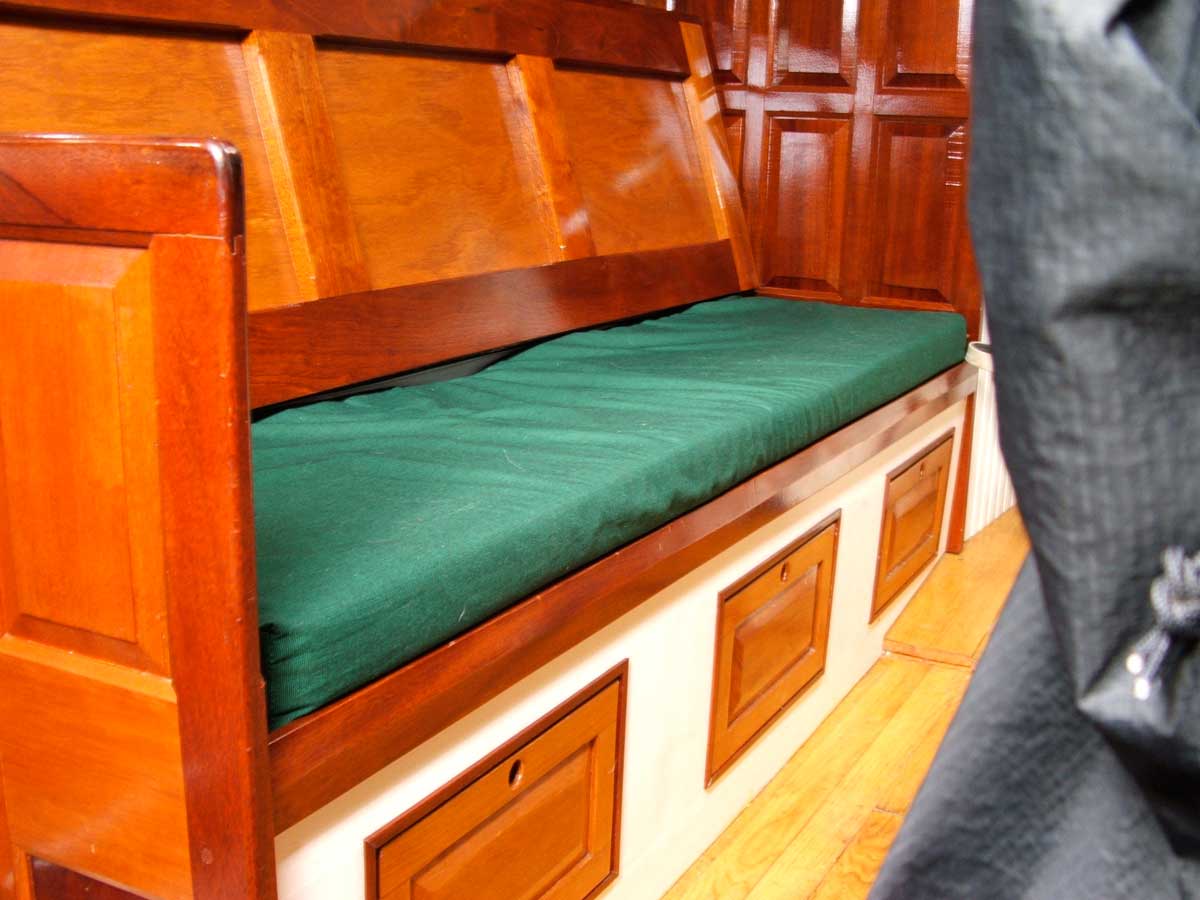
finished interior
It would take another winter to get the galley laid out, and a third winter before the coal stove and ice box were installed.
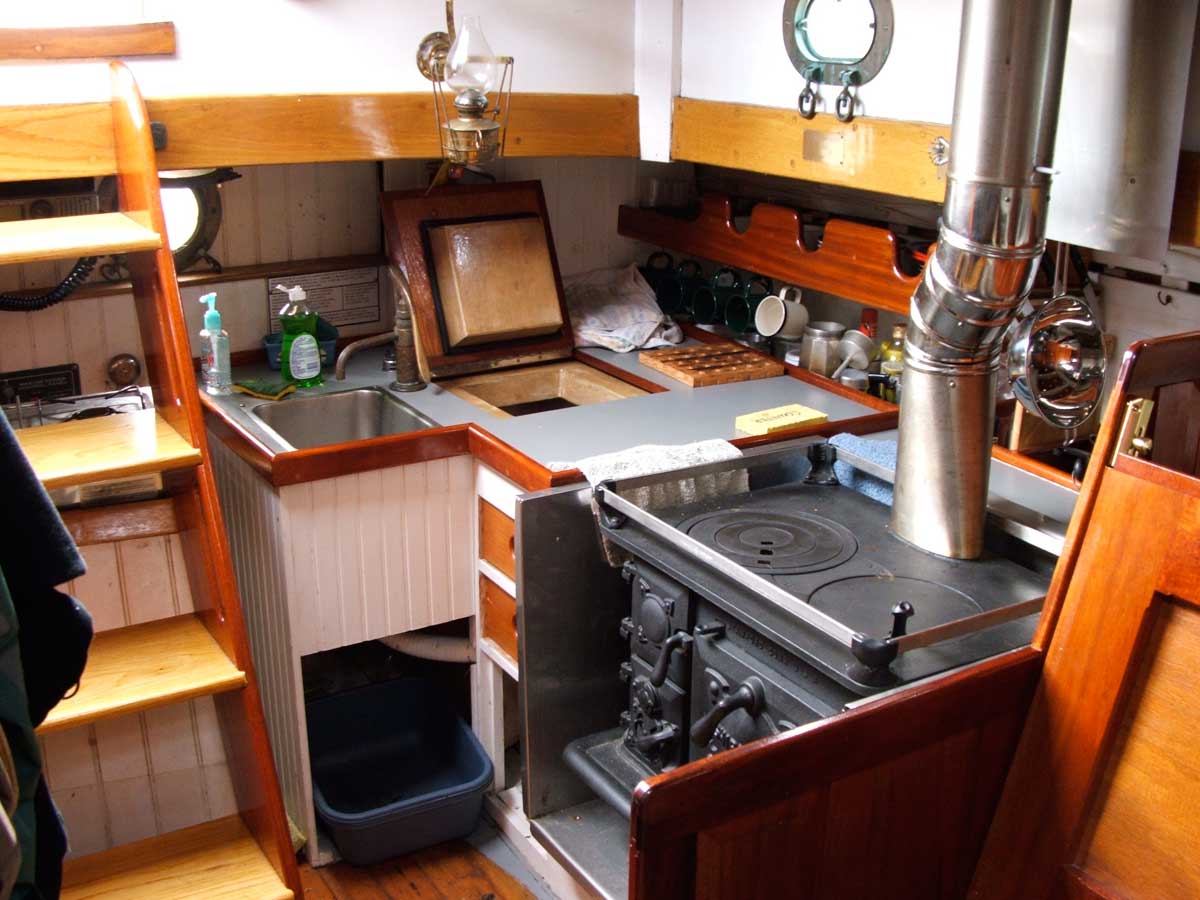
complete galley
Of course at the same time that I was working on the interior there were other issues to be seen to as well. The topping lifts had never worked, and needed the addition of gun tackles at the mast head in order to become functional. I had never been able to get the main topsail to set properly. After many attempts, and after seeking the advice of more experienced sailors, I still could not get this sail to draw efficiently. It then occurred to me to look at the original rigging drawings, which showed me that our gaff was too short. The next winter I fished 14” onto the end of the gaff, and relocated the sheave for the Main topsail sheet; now the sail sets beautifully.
There were other, less critical, puzzles to solve too. Our dinghy is a stout craft, and she serves us well, but no matter how the length of bow line is adjusted; she does not tow well. In fact she is sometimes referred to, not without affection, as the bath-tub. After much consideration the solution I kept coming back to was the addition of boat davits.
This was not as simple as it seemed. Our little ship has beautiful lines, I needed davits that could safely lift and secure the tender, but they also needed to compliment and not detract from such a beautiful Friendship Sloop. In the end we decided that even the perfect davit design would not always look right, an in some instances would even be in the way. The best solution appeared to be davits simple enough that they could be shipped and unshipped with ease. In the end I designed davits made up of oak laminates over white pine cores, and edged with steam bent rock maple. The result is strong, good looking, can be shipped in about five minutes, and struck below in even less time.
Clearly, the end design did not happen overnight; in fact it was fully two years between the first discussion and the final design. However, arriving at such a neat solution was not only worth it, the time spent tinkering with ideas, making mock-ups, and figuring out the details, was a lot of fun.
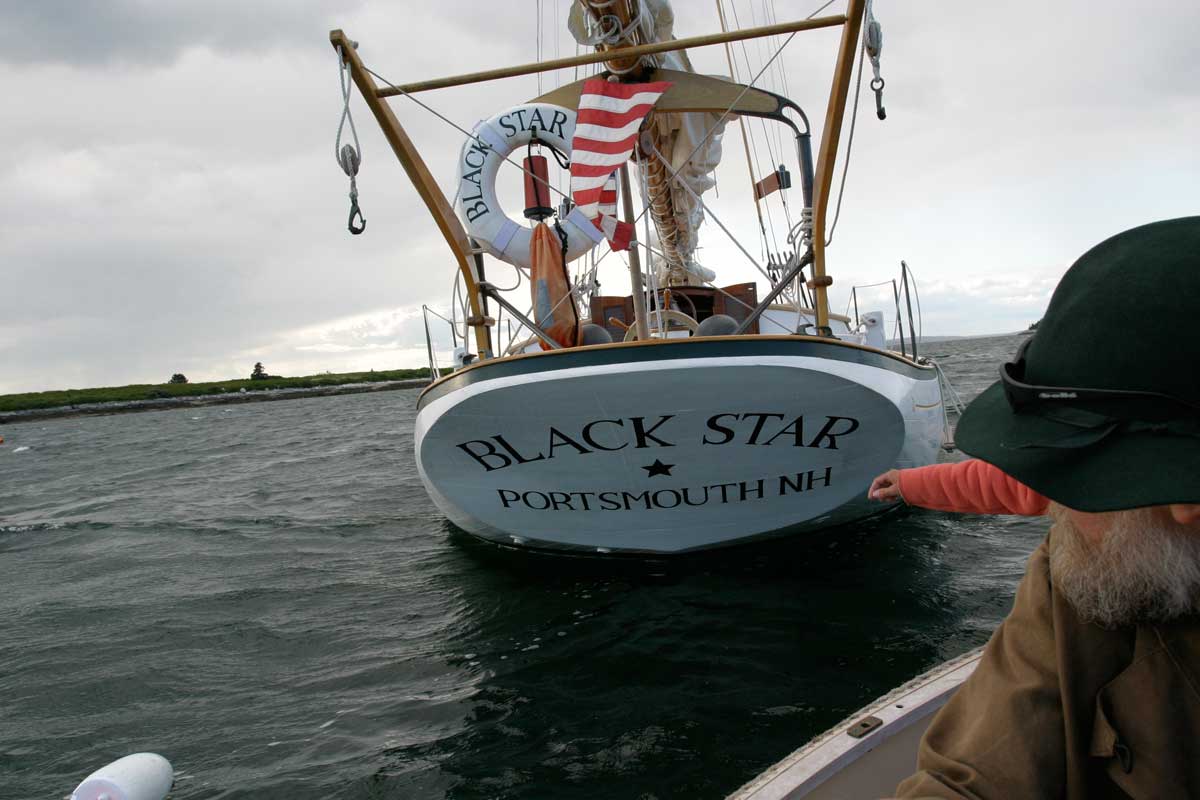
boat davits

boat aboard in davits
THE RIG
As you can see from the pictures above, our trusty vessel is big enough to be comfortable below decks. Above deck, she still provides ample room in the cockpit for crew or guests to spread out. These qualities have made it easy to introduce a number of friends and acquaintances to sailing. With a crew of one or two experienced sailors, she has also proven herself a sound and well-behaved sea boat in rough weather. Everything, however, has its price. The down side of running a small ship like this is apparent when I don’t have any crew. Taking out a ten ton, deep displacement, gaff-rigged boat alone is a bit like juggling running chainsaws. You can do it, but it takes lots of practice, and mistakes have grave consequences.

If you look at the rigging plan, above, the size of the rig becomes a little more apparent. The length of the vessel on the waterline is twenty-nine feet, on deck, thirty-five feet, but the overall length from the tip of the bowsprit to the boom end is fifty-three feet.
This particular Friendship Sloop carries a topmast, and is rigged so that the topmast can be “housed”; that is struck, or lowered, down on deck in case of heavy weather. This evolution is mostly theoretical, in our case, because it would involve someone going aloft to remove the fid at the masthead while someone else slacks the topmast backstays, and someone else eases the heel ropes, while a fourth crewman is at the helm.
If you are interested in the rigging details; click on the thumbnails below to see the rigging diagrams from the ship’s log book.


THE BOAT SHED
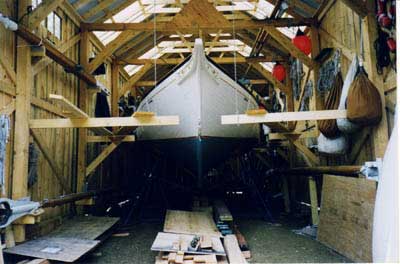
When we took on the stewardship of the boat, we decided to build a boatshed within walking distance of my home (see related post). The shed is a basic pole barn with a packed dirt floor to keep the humidity needed to allow a wooden boat to stay tight over the winter. The main structure is built of timber frame bents that are placed on granite blocks that extend down below the frost line. The roof is enameled steel roofing supported by conventional 2″x6″ trusses. The siding is rough-cut board and bat from a local mill.
You can see some of the basic construction in this drawing and in the photograph under it.


Before we started, we checked with the town to find out what the building regulations were, and to get a building permit. They were the ones who suggested we use granite blocks rather than poured concrete for the foundation. They made the suggestion based on how the building would be assessed for tax purposes. Using granite blocks for the foundation put the building in a different assessment category resulting in a lower tax. Since we already had a large pile of granite nearby at the building site, this also reduced our materials expenses. The point is that it is worth having a discussion with the town clerks office before you start a project like this.
The shed is designed so that simple staging can be hung on the interior walls of the building at about the waterline level of the boat; this allows us to work on any part of the boat without using ladders. Part of the area in the roof has an animal proof loft for storing sails, boat cushions, and anything else that you don’t want rodents getting into. The cost of the shed was equivalent to the cost of indoor storage for the boat for two winters in an average boat yard.
If you came to this page directly from another site and you would like to read more posts related to friendship sloops; go to the category column at the right and click “Friendship Sloop” .
The above clip was made sailing across Muscongus Bay in Maine in the Summer of 2007.
The skylight
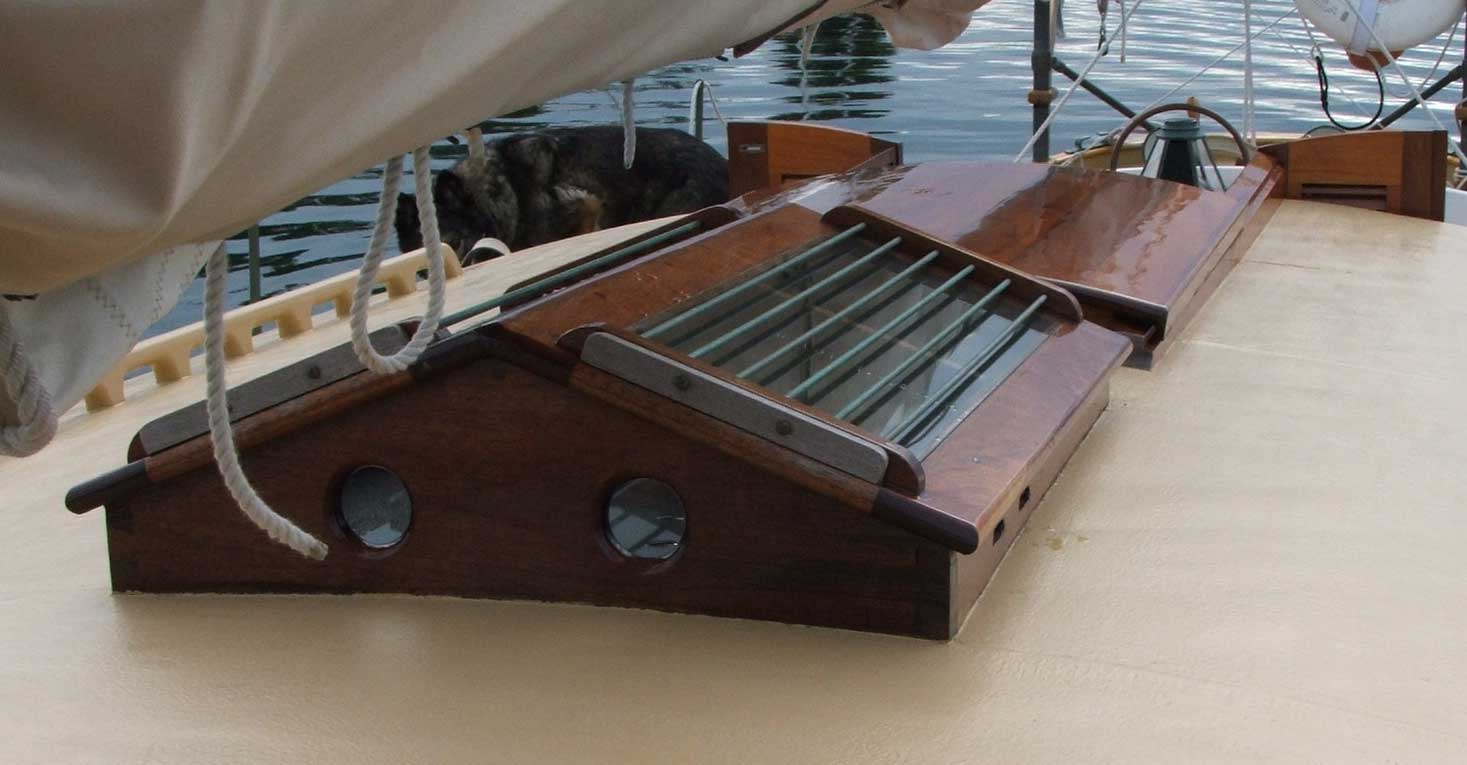
Related to the last post (see Raised Panel Bulkheads)…When we bought our friendship sloop, one of the few areas that needed a major rebuild was the cabin roof. This created an opportunity to build any kind of skylight that we wanted. The skylight that most people think of when they think of a classic wooden boat is the traditional “butterfly” hatch. I have always loved the look of these, but know of few that do not leak. What we decided to do instead was to build a version of this hatch that, as far as I know, legendary builder Bud McIntosh developed. It looks like a traditional skylight, but actually functions more like a large “dorade” ventilator.
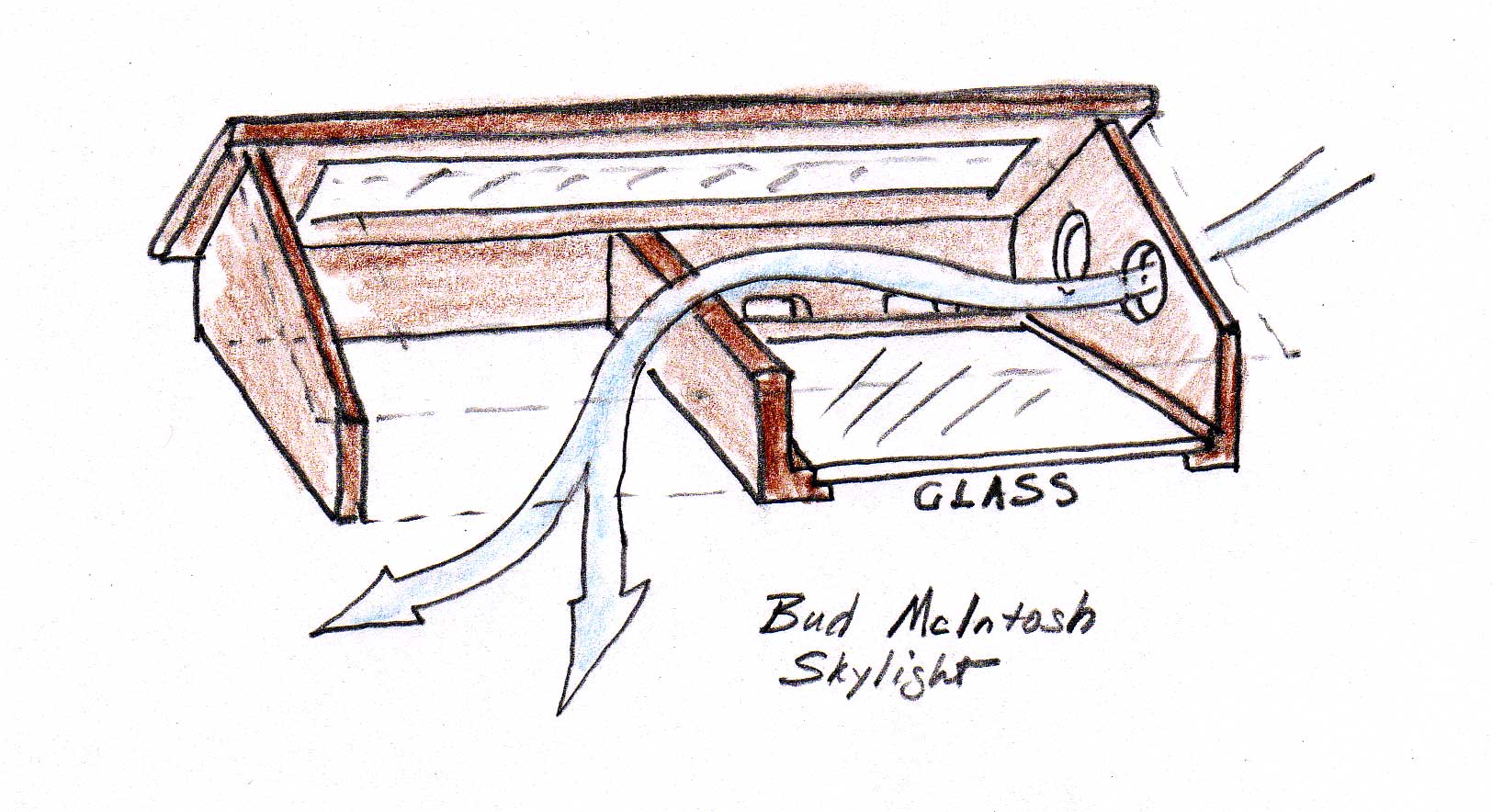
This solution has proven to be a particularly good one for our boat because when the boat is at anchor or on a mooring, air is continually circulating in the main cabin because of the way the skylight works. The Skylight looks great, allows for a lot of natural light below, and does not leak.
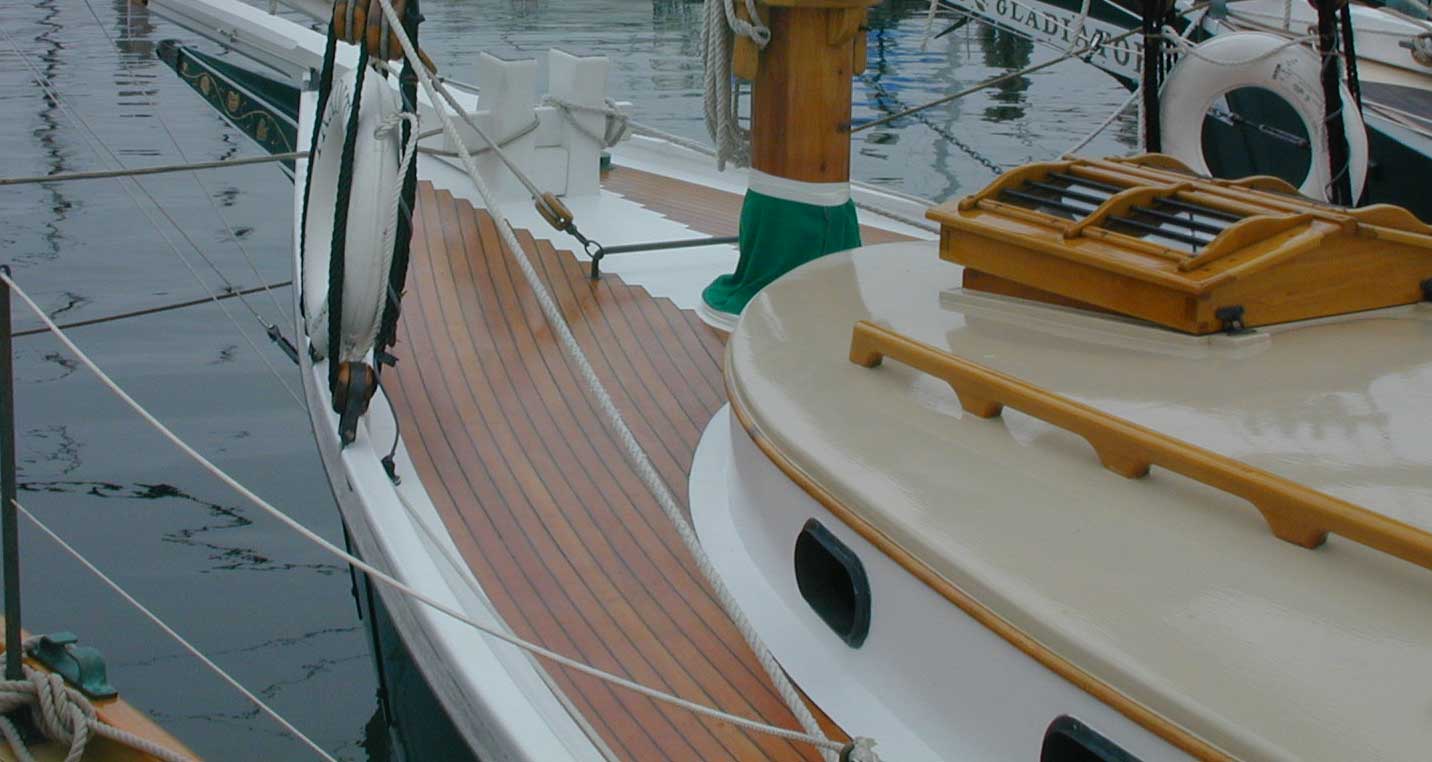
Another alternative to the more traditional butterfly skylight is to build a regular hatch opening and build the actual hatch in the shape of a butterfly skylight.
I took this picture of a hatch on a Jarvis Newman friendship sloop at one of our gatherings. It is fairly self explanatory.
The Friendship Sloop Homecoming in Rockland is held each year one weekend in July. It is a great opportunity to meet and visit with other boat owners, swap information, share yarns, and see other boats in the water. While other commitments kept the ship’s wolf and I from being at the event the entire time this year, we did manage to get out to the parade of sail on Saturday morning and to follow along with those of the fleet that were racing.
The video below is a condensed version of Saturday’s race…
Ship’s Wolf
February 15, 2007
My nearly constant companion for the last eight years has been a small wolf-hybrid named Saxon. Like any mix between a wild and a domesticated species, you never know what you are going to get. In this case, I think I won the lottery.
Along with genetic inheritance from Canis Lupus, my familiar spent most of the first two years of her life with wolves or wolf-hybrids, so when she came to me she had almost no domestic traits. However, she also came to me with few, or no, aggressive traits. The only times I have seen her become at all aggressive were when she thought children in her care were being threatened.
When I first introduced Saxon to sailing on the Friendship Sloop, she had some reservations. For wolves, however, being part of the pack and participating in the activities of the pack are a huge part of their identity, and if the pack is going sailing, then she is going sailing. It has been great fun to watch her apply her considerable powers of observation and assessment to cruising. She is now a tested sailor having sailed from Kittery, Maine to New Brunswick, Canada, and back four times, with many cruises in between.
While sailing is still not one of her favorite things to do she has repeatedly demonstrated the ability to make herself comfortable and useful at sea, and has become quite the sea dog…ah, wolf. Some of what Saxon has learned about cruising makes up what plot there is to the children’s book I wrote (see the post: “The Children’s Book“), here are a few more things she has learned:
Take a nap whenever you can, you never know when you may have to get up in the middle of the night.

When you are on watch, keep a good lookout.

Learn new skills.

And, a red sky at night, really is a sailor’s delight.

New and Old
April 28, 2008
Most of the rig on our friendship sloop is what is now called, perhaps euphemistically, “traditional.” In reality, this is a bit of smoke and mirrors. Sure we have the big gaff rig, no winches (too modern), deadeyes and lanyards, and a seemingly endless array of blocks, lines, hanks, and beckets that allow the deck gang to set, trim, and strike sails as the conditions warrant. Look deeper, however, and the compromises to modernity do begin to reveal themselves. Sails that are actually made of Dacron, stainless steel shrouds and stays, and even the occasional bit of plastic…yikes!
In fact, one of the compromises that I have been perfectly willing to make involves a material that sounds like something used in some sort of medical implant: Ultra High Molecular Weight Polyethylene. This material is manufactured, and sold specifically to woodworkers to make parts for power tool jigs. It is incredibly tough and has a slippery surface that makes it particularly good for jig parts that need to be able to slide smoothly.
One place I have used this high tech poly-stuff is on hatch slides. The main hatch had four bronze slides that did work, but that created a lot of wear on the wooden tracks in which they slide. The wear, in turn, caused the slides to stick. I replaced the track and at the same time replaced the slides with the high density jig stuff. The hatch now slides smoothly (almost too smoothly) and the wear has been all but eliminated.
Another area that this material has worked out well has been in sheaves for blocks. In particular, we were having a lot of difficulty with the jib-sheet blocks that are hanked onto the jib clew. The sheaves were very small in diameter and the bronze blocks themselves tended to foul in the mainstay. Tacking into a head sea has its own challenges without having to go forward and overhaul the jib sheets after each tack because either the blocks have fouled in the stay or the sheets refuse to slide through the blocks. As an experiment, I made up a pair of traditional bullet-blocks and stropped them onto the same thimble. I turned the sheaves out of the new-fangled jig stuff and hey-presto, the combination of traditional design and modern material did the trick.
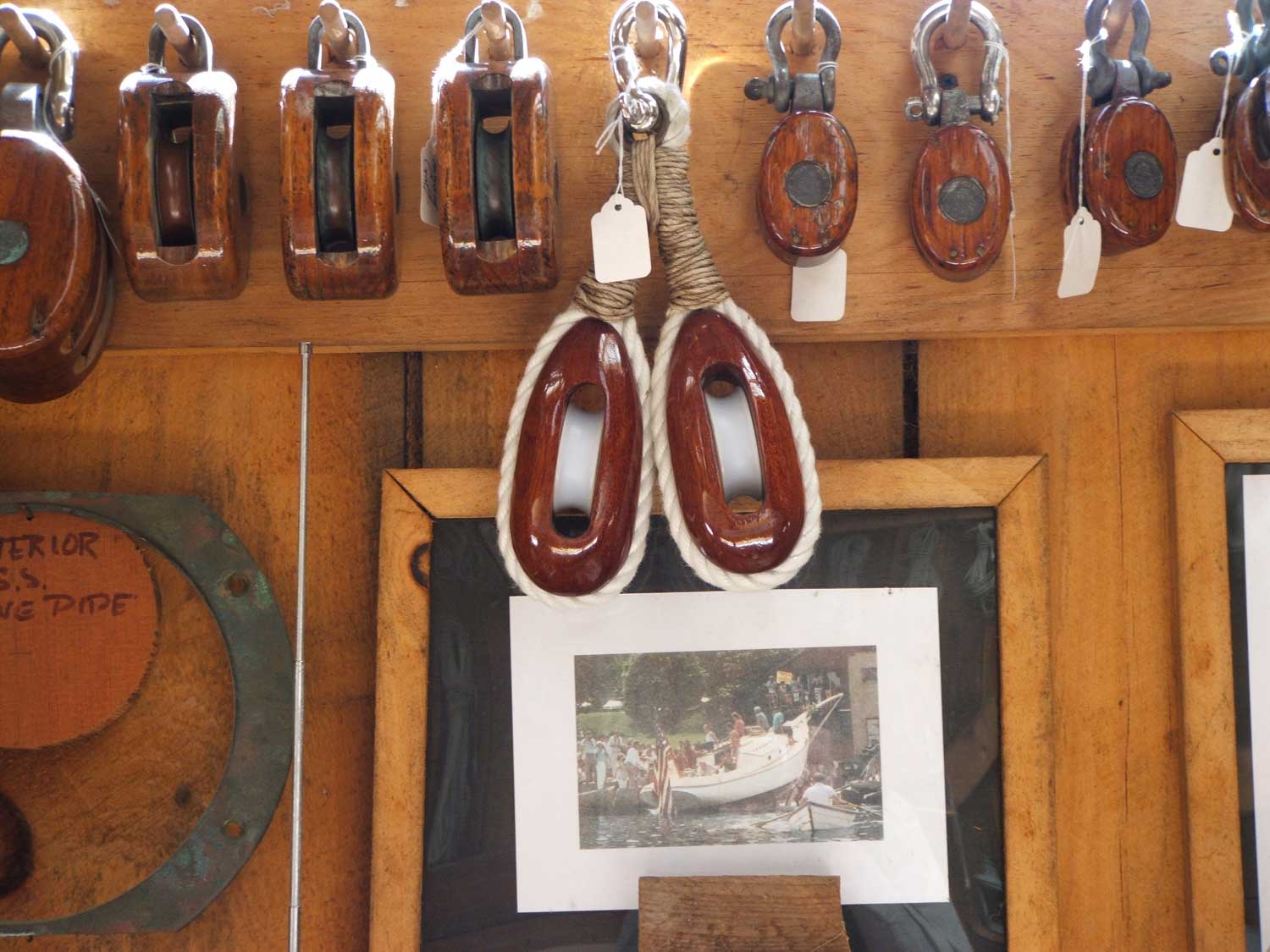
new bullet blocks
Posted in Friendship Sloop, Sailing, boatbuilding, wooden boats, woodworking | Edit | No Comments »
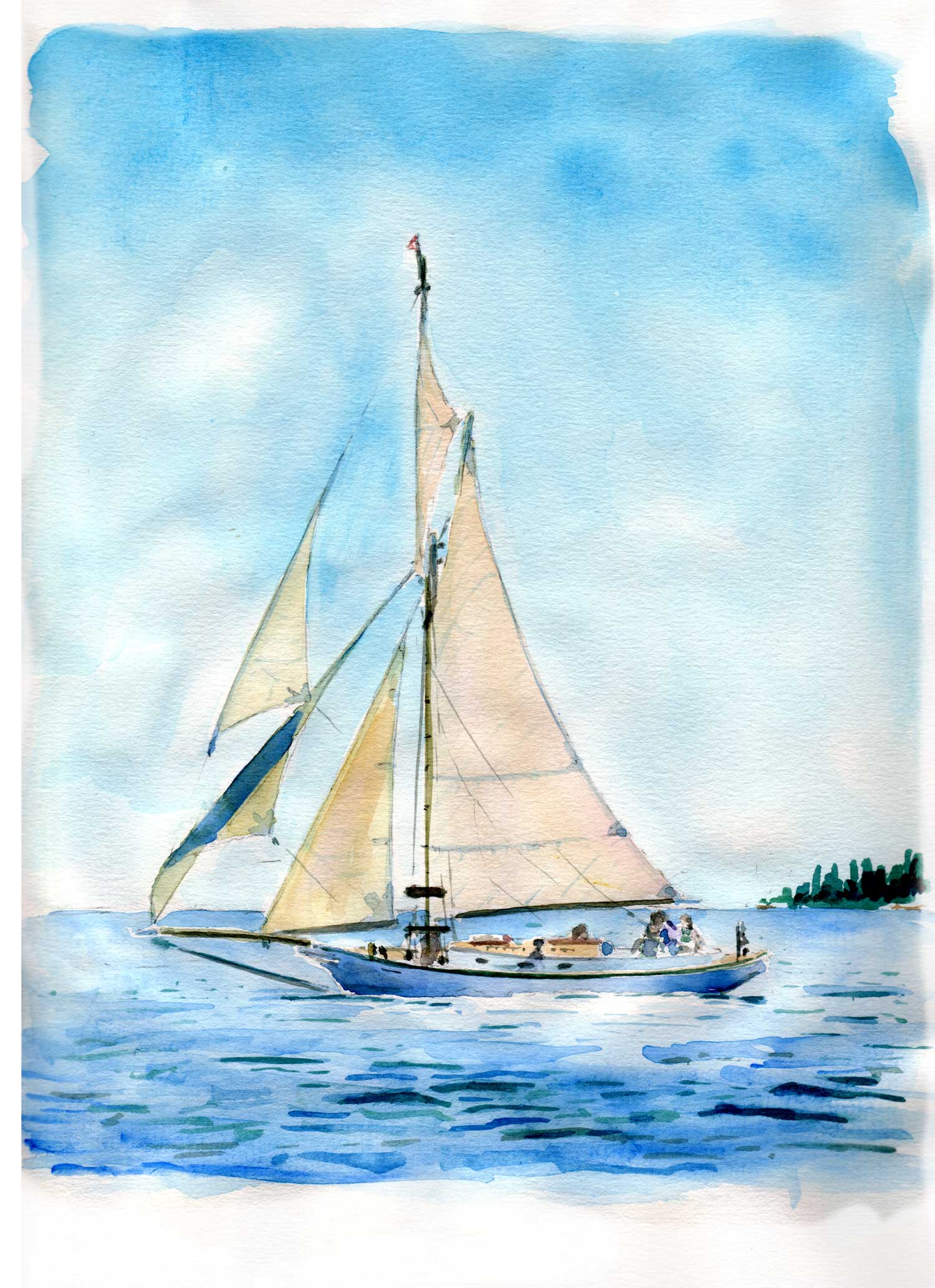
one of my watercolors of our boat with all sails set
2009 Friendship Sloop Races
This year the Friendship Sloop Homecoming and regatta in Rockland, Maine had twenty two boats in attendance. In addition on the second day of the races, a number of schooners formed a parade past the breakwater. The combined effect on this hazy afternoon of light air was a stately dance of traditional sail. I have put together four clips below. If you are so inclined, spend a few minutes watching a sight that used to be common on the Maine coast, and is now all too rare.

 Dovetails
January 20, 2007 at 12:58 pm |
Hi Ted-
Just reading your site and noticed an error- Friendships were built at the END of the 19th, and into the FIRST 1/4 of the 20th century….
Love the site! Great stuff!…………..peace, out……………miff
January 20, 2007 at 3:29 pm |
Thanks Miff,
You are, of course, completely correct Friendships Sloops were built predominantly in the late 19th and early part of the 20th Century. I should have clarified that our sloop was built at the end of the 20th Century (1988-89). I may go back and insert a sentence when I update this page.
Thanks again for checking this out.
Cheers,
Ted
February 27, 2007 at 7:58 pm |
Thanks for the information. I have been trying to find a set of plans or ofsets to build a Friendship Sloop in the 30 – 35 foot range. If you can help me in this matter, it would be greatly appreciated.
Thanks again,
Raymond Covey
Gray, Georgia
February 28, 2007 at 9:54 am |
Raymond,
There are a couple of places you can find drawings. One is the Smithsonian, they have two sets of drawings that I know of, one set is for the LIZZIE M., the other is I believe the RANGER, I don’t remember all the details, but I think the LIZZIE M. had more of a spoon bow and was about 35 or 36 feet on deck. If I remember correctly, the RANGER was smaller, perhaps 30 feet on deck. Anyway, they should still be available from the Smithsonian, although they may only have lines and possibly offsets, not detailed construction drawings.
Another place to contact is Mystic Seaport, they have a comprehensive library and may have plans for something in the size you are looking for.
A third contact is Roger Long http://www.rogerlongboats.com . He was the marine architect that took the lines from the 1903 Friendship Sloop RITA and did the construction drawings for our vessel in the late 1980’s.
If these prove to be dead ends, perhaps someone else reading this will post another, better, source for you.
Thanks for the question.
March 15, 2007 at 9:09 am |
Howdy and great site!
I just posted this on the FSS forum, but it looks like there’s not a lot of traffic there, so I thought I’d ask here as well.
I’m building a model of a gaff-rigged lobster well-smack from the late 1800s. Essentially a friendship sloop.
The kit I’m building from includes oar locks, but no oars. Would oar locks be common on lobster sloops from the pre-motor era? Are there any resources on what size of oars would typically be used? The ship would be about 30′ LOA with 7′ beam.
Any help would be appreciated.
March 15, 2007 at 10:05 am |
Lets see… I know oars, or sweeps were common, they still are, both Echo #52 and William Rand #218, have sweeps although they are smaller, 22 feet on deck. As to the size of the oars or sweeps, I am not sure.
A couple of suggestions: One is that there was an article in WoodenBoat several years back on “Sloop Boats” that had a lot of vintage photographs that may show sweeps either in use or stored on deck somewhere. Another is to call the Penobscot Marine Museum and ask if the Stephen Phillips Memorial Library has photo resources that you could check. There may be a research fee though so I would call and check first. A third would be to call Harold Burnham, you can find the number if you search Harold Burnham Boat Building in the Internet.
I hope this helps,
Good luck.
June 8, 2007 at 4:49 pm |
This Rocks……..
My Grandfather had one, those wonderful sails up and down
the Penobscot Bay. What a boat, so beautiful and sleek.
His Sloop still sails out of Bar Harbor for a charge.
Had I been an adult , when age forced sale, I would have found a way to have owned it.
Oh, try a dory style dinghy. They tow easier.
Best of Luck!!!!
C
January 19, 2008 at 8:30 pm |
Hi, Great site !! We enjoyed the video of her at sea.
Hope to see you at the New London rendezvous this year. Down East is covered, in the water and staying nice and tight up river in Narragansett Bay. We’ll be back at sea by March.
Bill and Donna and the rest of the Down East family and crew
January 20, 2008 at 11:46 am |
Wow back to sea in March…I can’t even imagine that. It won’t be warm enough here for me to start my annual painting till May. Thanks for checking out “dovetails”, I will look for Down East on the water,
Cheers,
Ted
January 28, 2008 at 7:17 pm |
Does anyone know whatever became of the Friendship Sloop
“Princess” which was imortalized in a wonderful book of the
same name (Library of Congress No. 72-95163) by Joe Rich-
ards? Or of Joe Richards himself?
January 29, 2008 at 4:51 pm |
Hi Dave,
Thanks for your comment. I wish I had more information for you, what I can tell you is this: Last summer the Friendship Sloop Society published a list of boats in the their newsletter about which the society has no current information. PRINCESS was on that list. The last owners listed with the Society lived in Florida and listed Sarasota as her home port. Those people may still own the boat but are no longer members of the Friendship Sloop Society, or they may have sold the boat to someone else, who either does not know about the FSS, or has chosen not to join. In either case, I would recommend that you contact John Wojcik at registrar@fss.org and see if he has any updated information.
Thanks again for checking out this site, let me know if you find her, and good luck!
March 21, 2008 at 12:17 am |
sad to relate, joe richards passed away 03/21/08, of pneumoia. he was 90 years old.
March 25, 2008 at 7:42 pm |
hi,
I am trying to find out information about Omaha..My father owner her in the 70’s and early 80’s. I read about an award in her name and would like to know more. Any information would be appreciated. thank you
megan
March 26, 2008 at 12:06 pm |
Hi Megan,
Thanks for your comment. My understanding is that Omaha is still around and is in Spruce Head, Maine. The last I heard the owners have been building a schooner (I think out of steel) and have not been able to divide their resources between two boats and have had Omaha for sale as a result.
Omaha was mentioned in a very recent article in the current Friendship Sloop Newsletter, Freelance writer Steve Cartwright is following the re-building of Eagle, and I gather Omaha is stored nearby.
I will email you directly the name of the current owners and the contact information that I have so you could call them directly.
Good luck, and thanks again your comment.
September 14, 2008 at 5:27 pm |
Hi my brother was a captain on boats. He also rebuilt them. He died recently because of a rescue out @ sea. Your boat reminds me of his last one. Kim
December 7, 2008 at 2:56 am |
hi
love the details of the rigging
Im also interested in building a model of the original lobsterman
and wish I had a way to find out were hardingb got his
I think I found a fairly accurate painting of one by Vern Broe
its #39 Sloop on his web site
but I want details and drawings so I can do an honest to original plank on frame
any ideas
B
December 14, 2008 at 11:52 am |
Hey B,
Thanks for checking out “dovetails”. I have been away from my virtual desk for a week, but when I get a chance to catch my breath, let me look through some folders and I think I might have some line drawings that would scale alright for a model.
Cheers,
March 31, 2009 at 4:46 pm |
I think that someone in the Lash family boatyard in Friendship probably has drawings for a somewhat smaller–say, 30′ on deck–sloop. They built Dirigo, which I sailed daily for 7 summers out of Camden, Maine. I rebuilt her with professional help in the winter of ’84-’85, and she was extremely fast and stable with the second lead keel bolted on and way too much sail. You’d want Roger Long to check out the stability numbers for any wooden Friendship if you plan to use her commercially with tourists…
April 1, 2009 at 8:28 am |
Good advice Bill. The Lash connection is a good one and Roger Long contacted me recently and I have updated the link to his site above.
Thanks for the comment…
April 27, 2009 at 2:20 pm |
I like you blog! We also have a friendship sloop and are currently making repairs on it. Its not as big as yours but there is alot of work to be done! It has been very enjoyable though because I fell like the boat is more ours now.
May 20, 2009 at 10:13 pm |
I’m confused about Phil Ventura’s comment about Joe Richards dying in 2008, age 90. The web site devoted to him and his work, http://www.joerichardsprincess.com/ ,
states that he was born in 1909 and died in1992.
If this is true, he would have been 99 years old in 2008.
May 21, 2009 at 8:17 am |
If I had to guess I would say that the website is correct. Thanks for the update.
August 5, 2009 at 1:51 pm |
I have a copy of Winnie Lash’s 1971 blue prints- taken from a wilbur morse 1/2 model. Dirigo, Rights of Man, and others were built from this plan as I understand it. Nancy and I purchased these in 1975 when we started both a sloop and our family. The family is well, the wood burned wonderfully. We own #232, a 22 foot Ahern hull. I’m sure that it would be possible to photo reproduce my drawings- they will NOT run through a roller printer. Anyone interested can e mail us at toppan@verizon.net– or call 617 212 7009 and leave a message.
August 5, 2009 at 2:24 pm |
Thanks Peter,
I hope someone contacts you!
Cheers,
December 27, 2009 at 11:48 am |
We have just bought a Jarvis Newman 31 foot Dictator class FSS. Any chance we could get the patterns for the Blackstar dinghy davits?
January 6, 2010 at 10:37 am |
Hi Alan,
I will email you directly. Congratulations on the new boat!
March 30, 2010 at 9:55 am |
Ah–seems a perpetual question…one in search of a set of Friendship plans…here in Brentwood, NH there isn’t much in the way of research facilities! I have tried a number of avenues…I am after a set of plans for a full keel boat, hopefully with a dramatic clipper bow, built circa 1900…to model. A client and my wife (who likes to see the first boat on the wall at home) really want “a classic Friendship.”I just finished the Ranger (from MMM) and am actually trying to find the home of the Chapelle-drawn plans on pg 270 of “American Small Sailing Craft” for the Pemaquid, ne Florida. I suspect the Smithsonian, but have not been able to prove/disprove that theory.
Thanks,
Steve Lauermann
April 9, 2010 at 2:17 pm |
Steve,
I looked around, but other than those already listed in the comments above, I have not found any additional sources for plans.
Good luck and thanks for checking out ‘Dovetails”.
August 29, 2010 at 8:32 pm |
Hi:
Is a friendship like this suitable for off shore cruising or just for coastal work?
Thanks
Best regards
August 30, 2010 at 10:41 am |
Your question is a good one and not as simple to answer as it might appear at first. The hull design of the Friendship sloop is very seaworthy, but it varies so much it is difficult to make sweeping generalizations. Smaller inshore vessels sometimes had shallower keels, depending more on a wide beam for stability rather than a deep keel and lots of ballast. As you might expect these boats tended to carry a baldheaded rig. The larger boats (deck length of 30 feet and more) were deep keeled, with internal ballast (mostly beach stone) fished in deep water and in all weather, however, the original rig of a larger friendship sloop requires a lot more muscle to manage than a modern cruiser. Further, those larger vessels that carry topmasts, have greater flexibility in light air, but add more wind resistance aloft and add several more halyards, shrouds, a stay, leader-or throat halyard, and backstays to an already complex rig.
Many owners of Friendships over the years have made their vessels far more manageable for distance cruising by adding modern compromises like roller furling on jibs, or replacing the staysail, jib combo with one larger fore-triangle that can be roller reefed and that is self-tacking. This kind of modification can do much to eliminate the more dangerous aspects of going forward to set and strike headsails on a heaving bowsprit or foredeck. That said, the mainsail can still be difficult to reef if left too late, so these modifications are far from a cure-all. And, as with any other compromise, such modifications have a price in that the multiple headsail rig results in the ability set sails in different combinations, depending on wind conditions, and each sail has less area making it more manageable. The single fore-triangle can require more muscle to trim given the larger area.
As with any boat heading off shore, the seaworthiness of the hull will depend to a certain extent on the soundness of hatches, ports, and the deck itself. When these vessels were extensively fished they tended to be, to a large extent, open boats. Now if it were me, I would consider a self-draining cockpit a must for someone going offshore. Another modification that came with the conversion of this design from workboats to pleasure craft was the addition of external ballast to increase the stiffness of the boat, and the replacement of beach stone for internal ballast with pig iron, or lead ingots secured beneath and between the floor-timbers.
So I guess the best answer to your question is that the appropriateness of the Friendship sloop to offshore cruising depends on the particular boat. Does it have a deep keel, external ballast as well as internal ballast, what is the rig like; does it have a self-bailing cockpit?
November 30, 2010 at 10:12 pm |
I love the design of “Black Star”!
I would like to make a 1″:1′ model of this fine vessel. Providence has caused me to loose my sailboat and I am now relegated to model building. Can you assist me in getting plans?
Thanks, Mark
December 29, 2010 at 12:41 pm |
I designed the boat and have the original plans. Contact me by direct email at:
roger@rogerlongboats.com
December 1, 2011 at 1:49 pm |
Excellent woodworking. I’ve built a few myself and appreciate your efforts.
February 28, 2012 at 2:58 pm |
What’s the sail area? I’m trying to design a Friendship sloop for one of my classes…
Thanks!
March 6, 2012 at 1:35 pm |
She carries a total sail area of 1156 square feet, with about 900 of that in her three lowers.
March 31, 2012 at 8:41 pm |
[…] at intheboatshed and his recent discovery of YouTube [ ;^) ],we now see that Ted at Dovetails has posted a nice video of his Friendship Sloop sailing in a brisk Westerly off mid-coast Maine. The page includes some nice profile drawings and photos as well –its a heck of a nice […]
November 20, 2013 at 7:14 pm |
I live in West Boothay Harbor and see you out sailing from time to time in Dark Star and in your tender. Who designed and/or built the tender?
November 21, 2013 at 8:45 am |
Hi Dave,
The design of the tender is by Ian Oughtred, the design name is the Penny Fee. We built her from a partial kit. If you go to the categories column on the right and click on “penny fee” the blog will pull together all of the posts regarding building the tender in one place for you.
We love that little cove in West Boothbay.
Thanks for the interest,
December 24, 2013 at 5:03 pm |
Ted and Judy
First off the Best of the Season to you and yours. We were excited to see your “Fee-Fie” gracing the pages of Wooden Boat mag this month. Check out this years Sept.issue and you will see “Pollywog lll” – my effort, not nearly as elegant as your build – I will have to come up and take lessons from you. How does the tender tow and can you get yer on deck?
Cheers, Dave and Kim
January 2, 2014 at 4:50 am |
Ted,
Although my 38×18 bow shed has been functioning adequately through the last few winters and last week’s ice storm, I’m going to replace it with something more sturdy, built from wood cut off my land. Do you have a materials list and dimensions that can augment your blog drawing? Would you do anything different if you had it to do over again?
Thanks for keeping this blog going. It is a great resource.
January 3, 2014 at 3:31 pm |
Bruce,
go to recent posts, I just posted the detailed plans there.
Cheers,
May 5, 2014 at 2:52 pm |
Hello! My husband and I recently purchased a beautiful 1969 Friendship Sloop. We are loving her and have already stacked up lifetime memories. Unfortunately, we were in the Chesapeake Bay this weekend and we’re hit with a freak microburst and the boom rack literally blew off the stern into the water. We would like to replace it, but we are not certain where to go. Any thoughts on where to start looking? Also, any reassurances that the boat will be okay without it would be very helpful, too. Thanks in advance for any help.
August 9, 2014 at 1:24 am |
Dovetails,
I just stumbled on your blog, and I must say your work, writing, and ship are all beautiful. While I do not own a Friendship, I hope to one day, and this blog makes me excited to do so.
Keep up the good work.
All the best,
November 9, 2014 at 7:44 am |
Wish I could have spent more time with you and Judy yesterday, Ted…I do so value the both of you for your knowledge and passion in all-things Friendship Sloop….love to visit you in NH someday over the winter, with my family (fair warning)!
Onward, Noel
September 23, 2015 at 1:15 pm |
#232 Compromise pulls on October 5th to end the season. It was certainly good to be back on the water this year and we look forward to having a grandson crew member for the 2016 season. See some of you in a few weeks at annual meeting! Cheers from N and P